Pension valuations: A headache avoided?


Pension valuations: A headache avoided?
22 Oct 2026
The new pension valuations rules were expected to be an onerous and potentially restrictive regulatory burden. But two years after their introduction, for most schemes this hasn’t come to pass. Nick Vine explains why.
Strong upfront planning
helps schemes avoid onerous compliance requirements
80%
of schemes expected to meet Fast Track criteria
10%
of schemes expected to be in technical provisions deficit
Valuations have evolved from
budgeting exercises to
Strategic
planning
tools
Bracing for change
When the new regime was being planned, there was apprehension among trustees preparing for their first valuations. The regulations require schemes to target a ‘low dependency’ funding position by the time the scheme is significantly mature. Many feared that this would force schemes into defensive, low-yielding investment strategies much earlier than
planned. Employer covenant requirements introduced new metrics that could potentially
further restrict time-frames due to a lack of long-term corporate visibility. All that, combined with the massive amount of granular detail required by The Pensions Regulator (TPR) via the new statement of strategy, made the process look likely to be a regulatory headache.
Funding improvements changed the narrative
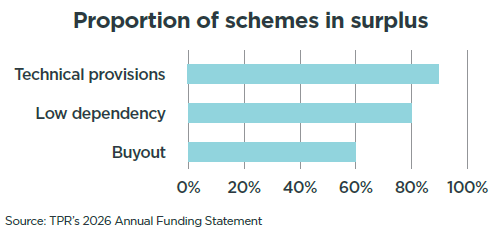
As the regulations came into effect, however, changing funding levels meant that the picture has been quite different. A dramatic rise in gilt yields over the last few years significantly reduced the value of scheme liabilities. Instead of struggling to fund deficits, many schemes unexpectedly found themselves in a much stronger position, in some cases boasting a healthy surplus on low dependency and even on an insurance buyout measure.
TPR recognised this shift.
A new role for valuations
Valuations have traditionally been a rigid budgeting exercise focused on managing deficits and securing cash. They have evolved into a strategic tool used to design, refine and track progress against long-term endgame goals. For well-funded schemes that already have long-term strategies integrated into their day-to-day operations, the valuation is simply a helpful checkpoint. For others, the recent funding improvements have provided an opportunity for constructive endgame planning.
Crucially, we have found that the most onerous compliance elements of the new regime often fall away when the valuation is well planned. The key is to avoid treating the statement of strategy as an afterthought.
By using the statement to drive the valuation from the outset - a pragmatic philosophy backed by TPR - the compliance burden can be significantly reduced.
The Fast Track advantage
The cleanest path to cutting complexity lies in TPR’s twin-track framework. Thanks to strong markets, TPR anticipates that around 80% of DB schemes can now meet the Fast Track criteria. Taking the time to understand the requirements of the Fast Track route
and its impact on the statement of strategy is clearly worthwhile. Going the extra mile to confirm that you meet Fast Track will likely be more than worth it.
While Bespoke remains vital in some circumstances, it demands extensive, potentially costly evidence to justify scheme-specific risks. For most well-funded arrangements, Fast Track is a no-brainer.
Fast Track can be further streamlined for schemes that are low-risk and at low dependency. In this scenario, expensive covenant requirements fall away, leaving a single, binary question: Is your covenant adequate? The market response to covenant should favour pragmatism. The strategic focus is now on active downside risk management rather than dense, costly
assessments. This is to be welcomed.
A deficit challenge remains
We acknowledge however, that a stark divide remains for schemes still trapped in deficit.
For these schemes, the valuation is still an intensive budgeting exercise heavily focused on deficit repair. As shortfalls must be eradicated as quickly as the sponsor can reasonably afford, these valuations will continue to centre on cash generation. For trustees of these schemes, mapping out endgame horizons or insurance buyouts can feel like a futile activity, but can help give structure to key funding and investment decisions.
In conclusion, the compliance framework remains extensive, but the path forward does not have to be painful. For most trustees, navigating the new regime successfully shouldn’t be a cause for stress. They’d feared rigid rules. Instead TPR gave them flexibility. And room to breathe.
Find out more
To discuss what run-on could mean for your scheme, speak to Nick Vine or your usual XPS Group contact.


- Register for events
- Join our mailing list
Register for events
We enjoy hosting a wide range of events for pension scheme trustees, corporate sponsors, independent trustees, and pensions professionals.
Join our mailing list
Keep up to date with our latest news and views including pension briefings, XPS insights, reports and event invitations.